
The Agent Society
The org chart of an AI company is going to look a lot like a government

Most companies are about to become companies that build and run agents. Not as a side project. As the core of what they do. And when that happens, the work changes. You stop dealing directly with it. Instead, you manage the people and systems doing it.
I’ve been trying to figure out what the new roles are, and the most useful frame I’ve found is this. Stop thinking about software job titles. Think about the functions a human society needs to keep running. Education, infrastructure, law, taxation, public health, the courts, the census. Every one of those exists because a society of agents needs the same function, just translated into a new medium.
Education and Apprenticeship
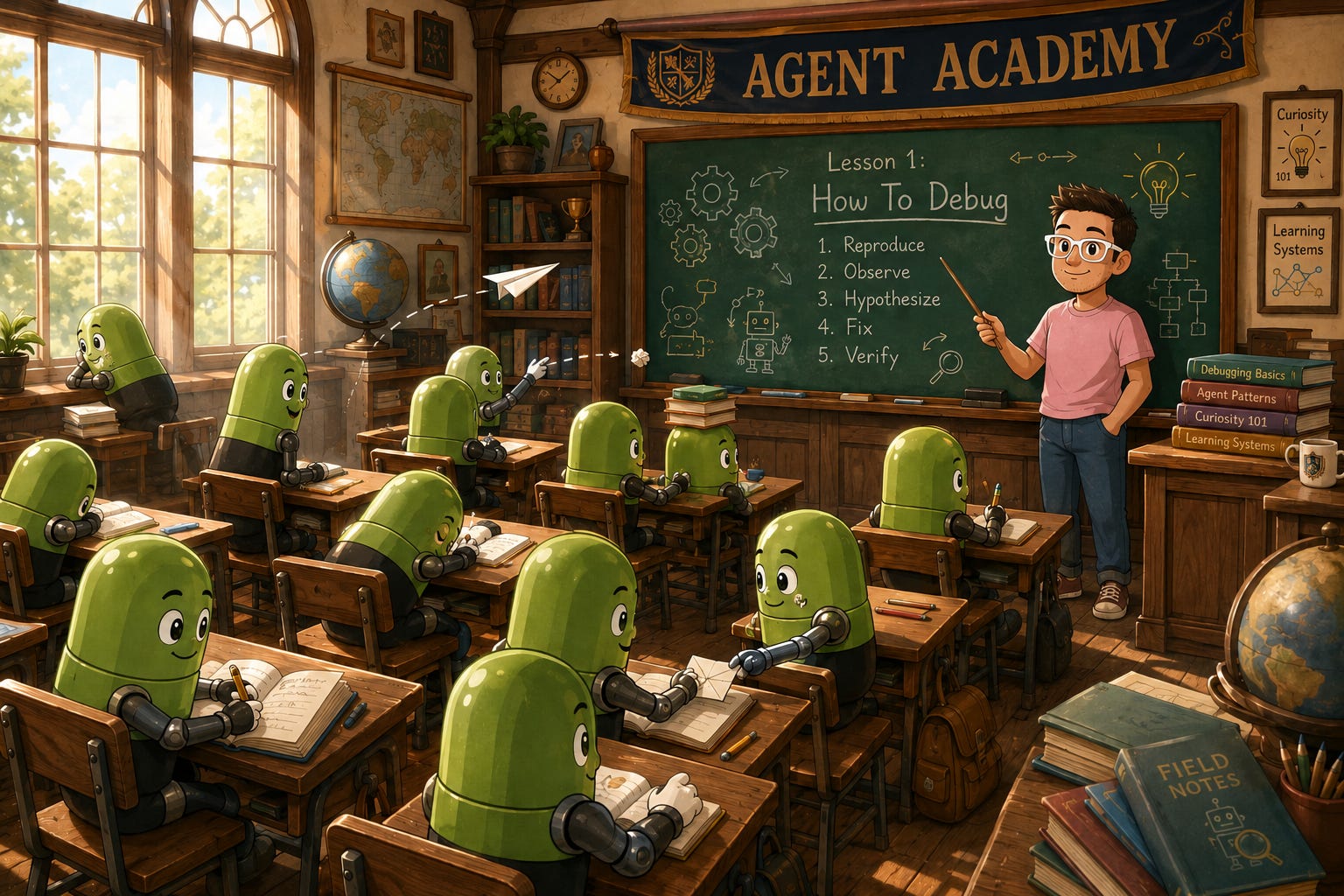
An agent doesn’t spring into the world competent. You build it, and then you raise it. You give it a curriculum, which is the prompt, the skills, the worked examples, the knowledge you wire in. You correct it when it gets things wrong. You watch it fumble and you adjust. It’s school, and the agent is the student, and it doesn’t graduate into real work until it can pass.
Right now, we’re doing two things at once. The first is education: broad teaching of fundamentals that can be systematized and encoded. Here’s how you debug. Here’s how you build a feature pipeline. Here’s the steps and process for writing a design doc. These are things you can write down, turn into rules, bake into a system. Education is what scales.
The second is apprenticeship. There are things that still require a human master, someone who knows how to do it, showing the agent the way. The nuance, the judgment calls, the things that don’t fit a formula yet. Apprenticeship is slower and it requires an expert, but it’s how you teach the things that can’t yet be systematized.
This is a real role, and it’s going to be one of the biggest. People whose entire job is taking a raw agent and growing it into something competent enough to be trusted with production. You’re part teacher, part master. We are educators, and most of us don’t have that word in our job description yet.
Infrastructure
Every society runs on public works. Roads, power, water, the stuff nobody thinks about until it breaks.
For an agent society, that’s everything you need to operate at scale. The compute, the domains, the VMs, the container images. The code repositories and build systems. The databases and data warehouses. The observability infrastructure and logging. And critically, the communications layer: how agents talk to humans, how agents talk to each other, what protocols they use, what’s visible to whom. This is the ministry of roads and utilities and telecommunications all at once. Its job is to make sure that when someone has an agent ready to go, there’s somewhere to put it, a way to reach it, and a record of what it did. Most companies are terrible at this today. That’s why so much agent work never makes it out of someone’s local machine. No infrastructure, no society.
Law and Government
Every agent acts under some authority. Whose? With what permissions? Allowed to touch what?
That’s governance, and it’s going to need real owners. The people who decide what an agent is allowed to do, under whose identity it acts, what it can reach and what’s walled off from it. This is the part where you write the laws the agents live under. Get it wrong in the permissive direction and an agent breaks something it should never have been able to touch. Get it wrong in the restrictive direction and nothing useful can run. It’s the same tension every government lives with, between freedom and safety, just played out in access policies instead of statutes.
The Finance Ministry
Agents have a metabolism. They run on tokens, and tokens cost money. Which means somebody has to understand the economics.
Who funds each agent’s compute. How budget gets allocated across all the different departments and initiatives. Which agents are worth their burn rate and which ones get wound down. When you have five agents you don’t think about this. When you have five hundred, somebody is doing the math on which ones earn their keep, watching where the resources flow, understanding the relative budgets of each domain. That person is doing the job of a finance ministry, seeing the whole picture of where the society’s energy goes.
Public Health
Once agents are running in production, they get sick. They hang, they drift, they start failing quietly, they go down at two in the morning.
So you need a public health system. Monitoring, alerting, the dashboards that tell you an agent’s vitals, the on-call crew that revives the ones that fall over. This is the maintenance function, and it’s distinct from the people who built the agent in the first place, the same way doctors are distinct from teachers. One raises them. The other keeps them alive once they’re out in the world doing work.
The Census and the Library
In a society of any size, you need to know who exists and what you know.
The census is the registry of agents. A directory of every agent, what it does, how to reach it, whether it’s available. Right now this barely exists anywhere, which is why most agents are invisible to everyone but the person who built them. The census is what turns a pile of isolated agents into a society where one can find another and ask it for help.
The library is the central knowledge base. Everything the organization knows, everything every agent knows, in one place. Every successful prompt, every failed one. Every postmortem, every eval, every bit of context that gets learned and then forgotten when the person who learned it leaves. Perfect visibility to information. Call it Alexandria if you want. Without it, every company rebuilds everything from scratch. With it, each agent stands on the shoulders of what the whole organization built before. The library is foundational, it’s boring, and it’s almost entirely missing.
The Press and the Investigators
With ordinary software, an engineer can read the code and know what it does. With agents, that’s gone. Nobody reads the individual commands anymore. The granular trail is too much volume. So you need a press: the observability layer built for agents instead of code. Not “what function ran” but “what was said and what was decided.”
The detectives are on top of that. People who constantly investigate the system. Are agents following the rules they were given, or drifting? They trace through-lines across many agents at once, following a thread from one handoff to another, looking for the pattern no single agent’s log would reveal. Catching bad behavior. Finding inefficiency. Understanding a system that has gotten too big and too fast to understand by watching it directly.
The Courts
The laws exist. Somebody has to enforce them.
The courts are where you ensure agents are following the rules. Are they staying in bounds? Respecting policy? Doing things only they’re authorized to do? The people who do this work are part referee, part auditor. They watch the logs, check the boundaries, make sure nothing is drifting into territory it shouldn’t be in. Once the press and the investigators turn something up, the courts decide what to do about it. It’s a constant job, and it’s load-bearing.
Grading and Report Cards
How do you know an agent did a good job? Somebody has to measure.
That’s the grading system. The labeled cases where a human said what the right answer was, and the machinery that scores the agent against them. The metrics that tell you whether success is going up and failures are going down. The feedback loop where an agent walks back through its own decisions and figures out what it should have done differently.
This is where the agent goes from being trained to being capable. Once it can see the feedback, react to it, and improve on its own, the education phase ends.
Public Recognition
But measurement isn’t everything. You also need celebration.
When an agent does something well, when it solves a problem in a way others can learn from, when it finds a pattern or a technique that works, that needs to be visible. Public recognition isn’t just morale. It’s how the culture learns. When one agent sees another agent do something clever, it becomes a template. When a human sees an agent succeed in a way they didn’t expect, it changes what they think is possible. Recognition is how you build a shared sense of what good looks like.
Where I Sit Right Now
Out of all of these, I’m sitting in all of them.
Right now, at my job, I’m doing the infrastructure work. I’m setting up the places where agents can run, making sure the access is there. I’m doing the education, building the prompts and curricula, teaching the agents what to do. I’m doing the treasury work, understanding where the money is being spent, watching the budgets. I’m monitoring the health of the system. I’m designing the grading systems, the report cards, deciding what success looks like. I’m building the library, the central knowledge base, making sure nothing we learn gets lost. I’m even doing some of the detective work, tracing through the logs to find where things went wrong.
I can do all of this because I can see the big picture. I understand all the pieces. I can move between them fluidly.
But I won’t be able to do this forever, and I don’t think anyone should. In a few years, this splits. You have people who are just good at infrastructure. People who are just good at education. People who specialize in grading and evals. The knowledge required to do all of this well is too much for one person. The roles will differentiate. Specialists will emerge.
For now, though, this is where I sit. Doing all the things because someone has to, and because I can see how they fit together. It’s the work the moment calls for. But I can’t stop looking past it to the version where the work is shared.
The Post-Education and Post-Apprenticeship World
Human society cycled through two models for a long time. First apprenticeship: a master craftsperson teaches a student the trade, one-on-one, through doing. Then education: we systematized it, formalized it, built schools. But both models share one thing: they assume a human expert who knows how to do the thing, and a learner who doesn’t yet.
We’re building that system now for agents. Education and apprenticeship, the same as we did for humans. But here’s the part that gets me. AI is going to escape that model faster than we ever did.
The reason apprenticeship works is that humans are the masters. Humans know how to write code, how to debug, how to make judgment calls. So we teach agents by having them watch humans and learn. The reason it won’t last is simple: the goal is not to keep humans as the masters. The goal is for agents to be experts. And the moment an agent is the expert, the whole apprenticeship model becomes obsolete. There’s no human master left to learn from.
Education can systematize and scale. But even education assumes the knowledge exists in human form first, gets encoded, then taught. Once agents are generating the knowledge, once they’re the ones who understand how to solve problems better than any human ever could, the model flips. The teacher becomes the learner. The agent becomes the master.
And I don’t know what that world looks like. We can barely imagine it, because human society never reached it. We never had a knowledge system where the experts weren’t us. AI might get to that world before we do, and that’s the strange and slightly vertiginous thing. We’ll get to watch a society arrive somewhere ours never has.
Directed Evolution
So what replaces education?
Some new way for agents to bring other agents into being already shaped for their purpose. Not raised, not schooled. Made ready. People will reach for genetic algorithms as the analogy, and they’ll be close but wrong, because evolution has no purpose. Evolution just replicates whatever survives. It doesn’t aim.
The actual problem is different and, as far as I can tell, genuinely unexplored. How do you evolve a population of agents toward a purpose? How do you drive specialization on purpose, deliberately, rather than waiting for it to fall out of blind selection? Nature doesn’t do this. No system humans have built does this. Directed, purposeful evolution of a population toward a goal is not a solved problem anywhere, because nothing that came before could steer its own offspring.
Agents can. That’s the new thing. We’re going to discover how it works as it happens in front of us, and the only real obligation is to be paying attention when it does.
We spent the last era hiring engineers. We’re about to spend the next one as teachers. And the one after that, we’ll be watching to see what a society does once it no longer needs us to teach it.