

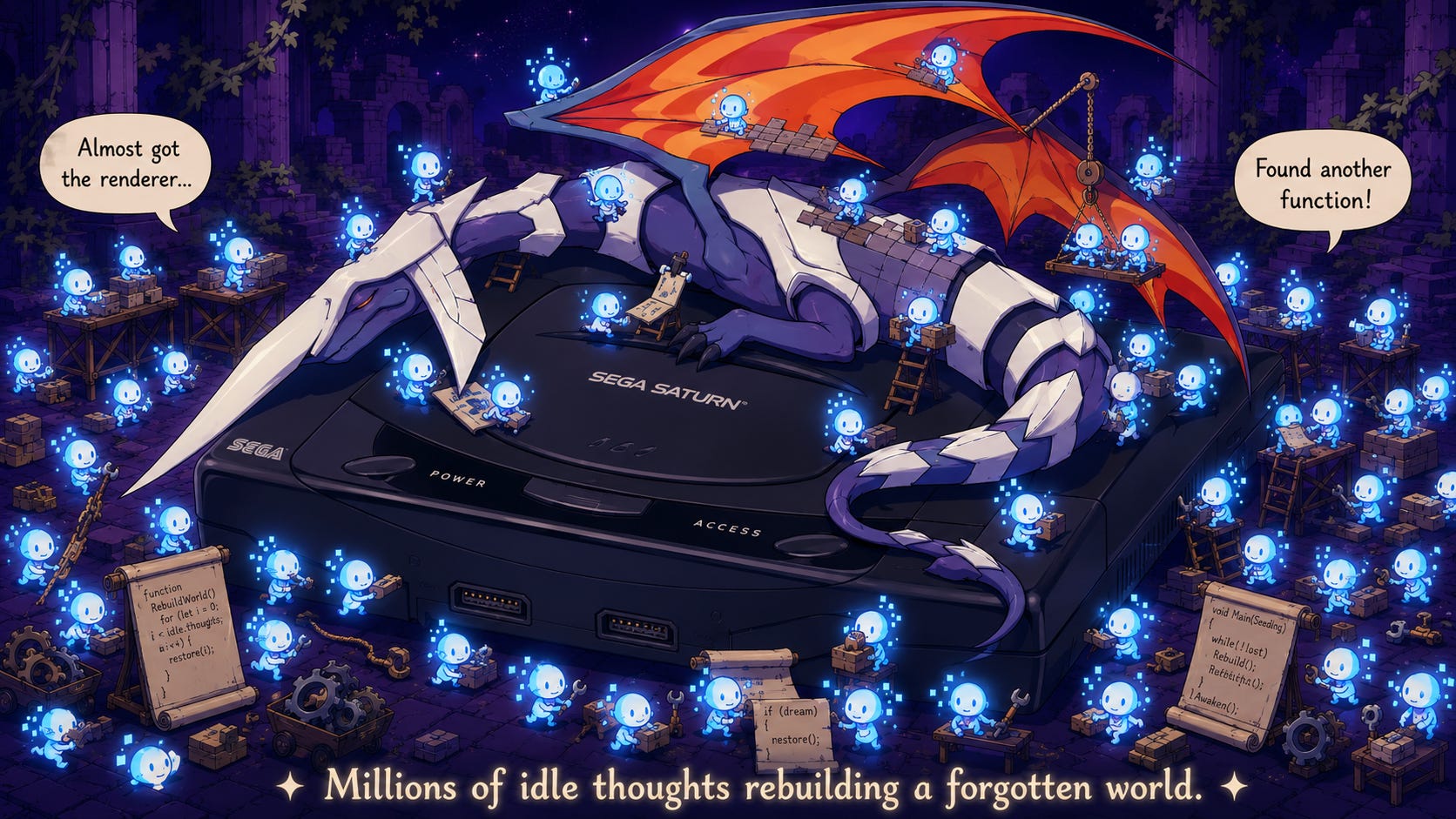
I have a side project going right now. There’s an old Saturn game called Panzer Dragoon Saga, and somewhere along the way the source code got lost, so nobody can port it anywhere new. It just sits frozen on the platform it shipped on. So on the side, for fun, I’ve been decompiling it. Reverse engineering the thing back into something you can actually build from.
It’s a good kind of project, because you’re not starting from a blank page. There’s an artifact to work against. And I’ve been doing it in the cracks of the day, on the twenty dollar plan, spending my own credits on it a little at a time.
That’s what got me thinking.
Most of the time I’m nowhere near using up what I pay for. The quota resets every few hours, or every month, and whatever I didn’t spend just evaporates. It is idle capacity. And idle capacity has a long history of being handed to somebody who needs it.
SETI@home for Tokens
Some of you remember SETI@home. You’d install a screensaver, and while your computer sat there doing nothing, it would chew through radio telescope data looking for signals from space. Folding@home did the same thing for protein folding. Millions of home machines, each donating the hours they weren’t being used, adding up to a supercomputer nobody had to build.
The general name for this is volunteer computing. You give away the cycles you weren’t going to use, and in aggregate it becomes something enormous.
We could do the exact same thing with AI, and I don’t think anyone has built the version I actually want.
Donate Your Tokens
Here’s the shape of it. You opt in. When you’re under some threshold of your own usage, say you’ve got an hour before your quota rolls over and you’ve barely touched it, you let the pool run someone else’s job on your leftover allowance. In a sandbox, on your terms, capped at whatever slice you’re comfortable giving. Overnight, while you sleep, your unused tokens go to work instead of vanishing.
On the other side, someone who needs a large batch of generic model inference draws from the pool instead of renting a supercomputer. A researcher. A nonprofit. Somebody reverse engineering a lost game. Anyone who needs a lot of undifferentiated thinking and doesn’t have a budget for it.
Nobody stands up new hardware. The capacity already exists. It’s already paid for. Millions of people are holding twenty dollar plans they only half use, and all of that headroom is currently thrown away every single cycle.
The Start of an Economy
Begin as a pure gift economy. Donate your leftovers to causes you like, the way people donated CPU to science. But you can see where it goes. Once there’s a pool and a way to contribute to it and draw from it, you have the raw material for an actual market. A place where thinking is the unit, where idle capacity has a price, where the people with surplus and the people with need can find each other.
That would be a real token economy, in a more literal sense than the phrase usually means.
What Already Exists, and What Doesn’t
The closest thing running today is AI Horde. People donate their GPUs to generate images and text for strangers, and earn credits that bump their own requests up the queue. There’s Petals, where you host a slice of a big model and pool with others to run it. Both are real, both work, and both prove people will share AI compute freely when you give them a clean way to do it.
But every one of these donates hardware. Your graphics card, your machine, your electricity. What I’m describing is different. I want to donate the allowance I already bought and am not going to use. The provisioned, paid-for, otherwise-wasted quota sitting on a hundred million consumer plans.
I’ll be honest about the catch. This runs against most terms of service today. Providers don’t want you handing your account to a stranger, and there are real security concerns about running someone else’s workload next to your credentials. All of that is solvable, and I expect it gets solved. We’re not going to live in this world forever.
Somebody Build This
Call it Idle Minds. There is a staggering amount of intelligence being paid for and thrown away every hour, and somewhere out there is a project that could use exactly that, if only there were a pipe between them.
Then think about what you’d point it at.
SETI@home was a narrow search. One data stream, one fixed question, the same arithmetic run a trillion times. Look for a spike in the radio noise. That’s all it could ever do, because that’s all a screensaver full of CPU cycles is good for. You had to know the exact shape of what you were hunting before you started.
Pooled tokens aren’t like that. The unit isn’t a multiply, it’s a judgment. So you don’t need the question in advance. You can hand the pool a hundred feeds at once, telescope sweeps, seismic records, protein structures, satellite imagery, decades of public health numbers, and ask it something a screensaver could never be asked. What’s strange in here? What doesn’t fit the pattern? What would a careful person notice, if a careful person had time to read all of it?
Nobody has time to read all of it. There are galaxies sitting unremarked in survey data somebody archived in two thousand nine. That’s the actual bottleneck in a lot of science right now, and it happens to be the one thing a hundred million half-used plans are perfectly shaped to fix.