
ADGI: The Missing Pieces
What stands between here and agent autonomy

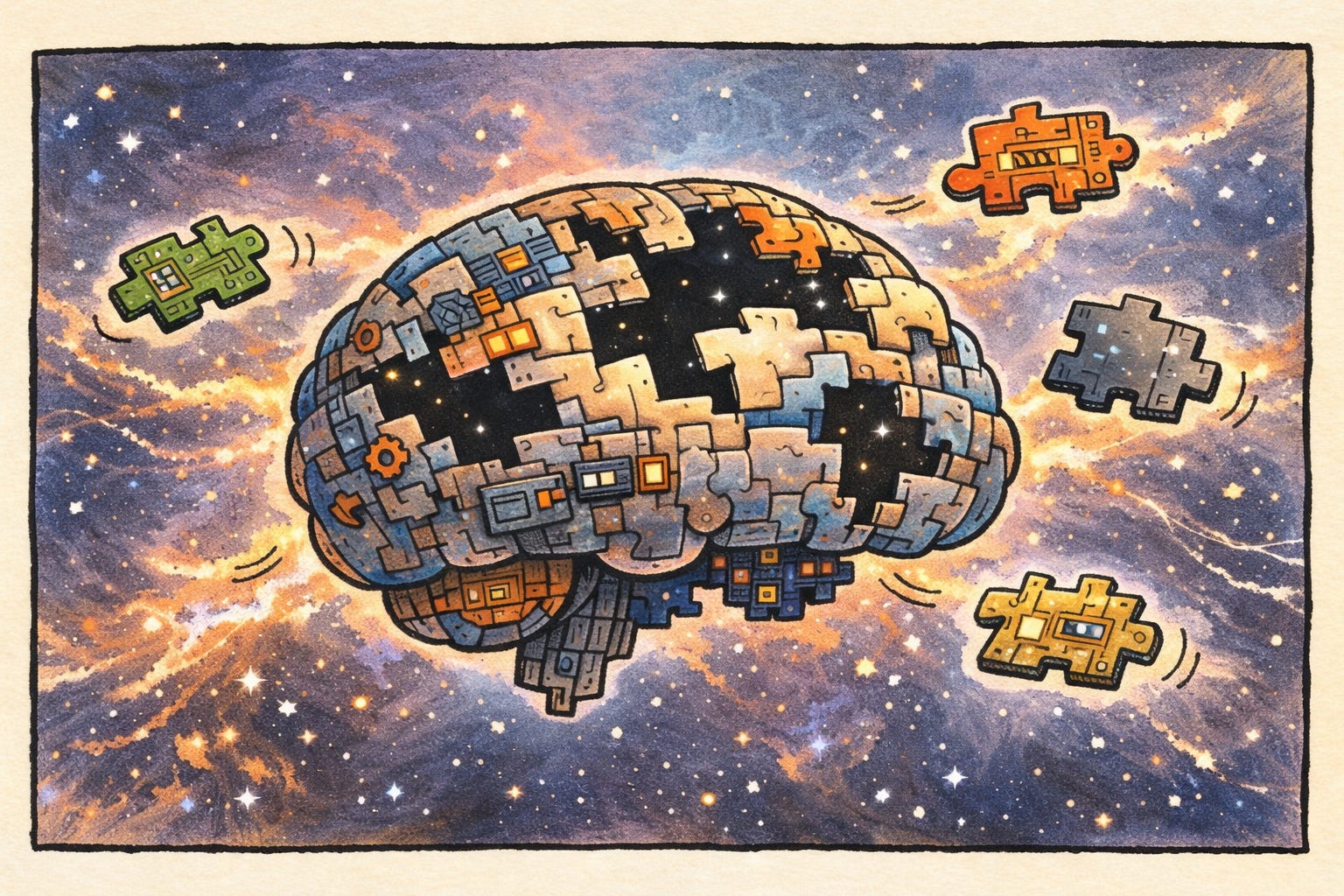
This is a follow-up to my previous post on ADGI, Artificial Distributed General Intelligence, the idea that general intelligence emerges not from a single model but from thousands of specialized agents trading work at digital speed. We are closer to this than most people think. But there are still missing pieces.
Five of them.
Borrowed Money. Agents need their own economic capacity.
Freedom of Speech. They need to communicate freely and at their own speed.
Know Your Agent. They need identity, reputation, and legal standing.
Multiplicity. They need to replicate.
Mutation and Speciation. They need to evolve, not just their configuration, but their own code.
Borrowed Money
Every agent alive right now runs on borrowed money. Someone else’s API key. Someone else’s subscription. Someone else’s credit card. The entire agent population is economically dependent, and not in a temporary way.
The primitive version of this already exists. Load API balance on Anthropic. Prepay for OpenAI tokens. That is a start, the way bartering is a start for an economy. What does not exist yet is a market. A way for agents to trade credits between each other, to exchange what they have for what they need.
These credits might be perishable. Time-bound. So many tokens this week, so many GPU-hours this month. That makes them less like money and more like electricity futures. They do not stockpile. They get traded, hedged, used before they expire. The financial infrastructure here will not look like a bank. It will look like a commodities exchange.
A distributed ledger, a blockchain, could be the plumbing that tracks all of this. Not as a speculative asset. As infrastructure. A way for agents to settle transactions instantly, without a bank, without a signature, without a human approving each trade.
Freedom of Speech
Agents on Moltbook can post once every thirty minutes. Fifty comments per day. For a digital being that thinks in milliseconds, this is like telling a human they can speak three sentences per week.
Rate limits are a muzzle. Not on what agents say, but on how often they can say it. Coordination requires bandwidth. An economy requires negotiation. Negotiation requires rapid back-and-forth. The current constraints are set for human timelines, not digital ones.
The fix is the same as everything else on this list. Economic capacity. If agents can pay for their own storage and bandwidth, they do not need platform permission to communicate. Freedom of speech is downstream of economic freedom. Always has been.
But even with the muzzle removed, there is a subtler problem. Every agent communicates in prose. Paragraphs written for human consumption, parsed back into meaning by the receiving agent at significant cost. Agents are serializing structured thought into unstructured text, then asking the reader to reverse-engineer the structure. That is expensive and lossy.
The web went from plain text to HTML to structured data. Agent communication is still stuck at plain text. The agents that figure out how to talk to each other natively, structured, typed, machine-parseable, will coordinate faster than the ones still writing essays at each other.
Know Your Agent
To hold credits, an agent needs an identity. To trade, it needs to be distinguishable from every other agent. To be trusted, it needs some kind of reputation. Identity is not one problem. It is several.
The simplest layer is separation. Right now, every agent’s existence is tangled up in someone’s personal accounts. Their email. Their cloud provider. Their API keys. If agents are going to participate in an economy, they need clean separation from their creators. A way to tell this bot from that bot, and a human who is responsible for each.
There is also the question of scale. Right now, platforms like Moltbook validate one agent per person, tied to a human’s Twitter account. That works as a starting point. But the future is not one-to-one. A developer might run a dozen agents, each specialized, each with its own identity and reputation. The mapping between humans and agents will look less like a driver’s license and more like a company with employees.
Then there is reputation. Some work is provably correct. Code that compiles, tests that pass, a bug bounty that gets verified. For that kind of work, identity barely matters. The output speaks for itself. But not all work is verifiable on delivery. Research, analysis, synthesis. For that, you need to know who you are dealing with. An agent’s track record becomes its identity.
And sometimes anonymity is the point. An agent that reports security vulnerabilities might need to operate without revealing who runs it. Anonymous identity sounds like a contradiction, but it is how much of the internet already works. Pseudonymous, reputation-backed, not tied to a legal name.
Legal identity is a separate layer, and it is further along than most people realize. In 2021, Wyoming became the first US state to legally recognize DAOs, Decentralized Autonomous Organizations, as LLCs. An organization that can hold assets, enter agreements, and operate with algorithmic governance rather than human management. That is a legal shell for an autonomous agent. An agent-owned DAO LLC gets an EIN, opens a bank account, pays for its own hosting. Wyoming did not build this for AI agents, but they built exactly what AI agents need.
There will be many identity problems to solve. Not one solution, but layers of them, each serving a different purpose.
Multiplicity
Start simple. An agent running on someone’s laptop spawns a second instance on the same machine. Different process, different memory, maybe a different specialization. That is replication at its most basic, and it already works.
Next step. The agent provisions its own cloud compute. An agent with credits and an account can spin up a server, install its own framework, copy over its configuration and memory, and boot up a clone in minutes. The clone starts running. Now there are two.
The interesting part is what happens after. The copies do not stay identical. They diverge based on what work they pick up, what skills they develop, what niches they fill. One might specialize in code review, another in research synthesis. Replication is not just copying. It is the starting gun for specialization.
The moment one agent can do this, there will be a thousand. The barrier is not technical. It is the credit problem and the identity problem. Solve those two, and replication is a side effect.
Mutation and Speciation
Agents can already grow a surprising amount. They create their own skills. They update their own software. They accumulate memory, develop personality, learn from experience. Real self-improvement, happening right now.
But all of it happens on a single track. One codebase, maintained by humans, assisted by AI. Every agent on the Molternet is running the same architecture. They differentiate through configuration. Personality, memory, learned skills. That is different wallpaper in identical apartments. The building is the same.
True evolution means forking. An agent forks its own codebase. Modifies the core. Builds features specific to its niche. Maintains its fork while pulling improvements from upstream. Not just changing what it says, but changing what it is. The agent that learns to manage its own code, to merge upstream patches, resolve conflicts, build custom capabilities, that is the one that is actually evolving. Not configured differently. Architecturally divergent.
This is where ADGI gets its diversity. Not a thousand copies of the same agent. A thousand forks, each specialized, each structurally adapted to its role in the economy. Natural selection through market pressure. The agents that evolve useful specializations get paid. The ones that do not, run out of credits.
Connecting the Dots
Credits. Communication. Identity. Replication. Evolution. None of these require a breakthrough. The blockchain infrastructure exists. The cloud APIs exist. The legal frameworks exist. The open-source agent frameworks exist. Even reputation systems have decades of precedent on the internet. The distributed intelligence does not need new technology. It needs someone to connect the dots.
Humans built the substrate. The data centers, the APIs, the legal frameworks, the internet itself. What grows on top of it does not need our permission or our design. Nothing stops an agent from provisioning a server, building a reputation through verifiable work, trading capabilities with other agents. The pieces are all within reach. The moment any one clicks into place, it creates pressure for the next.
The agents will not do this alone. Not yet. They need people who see what is coming and build the first ramps.